


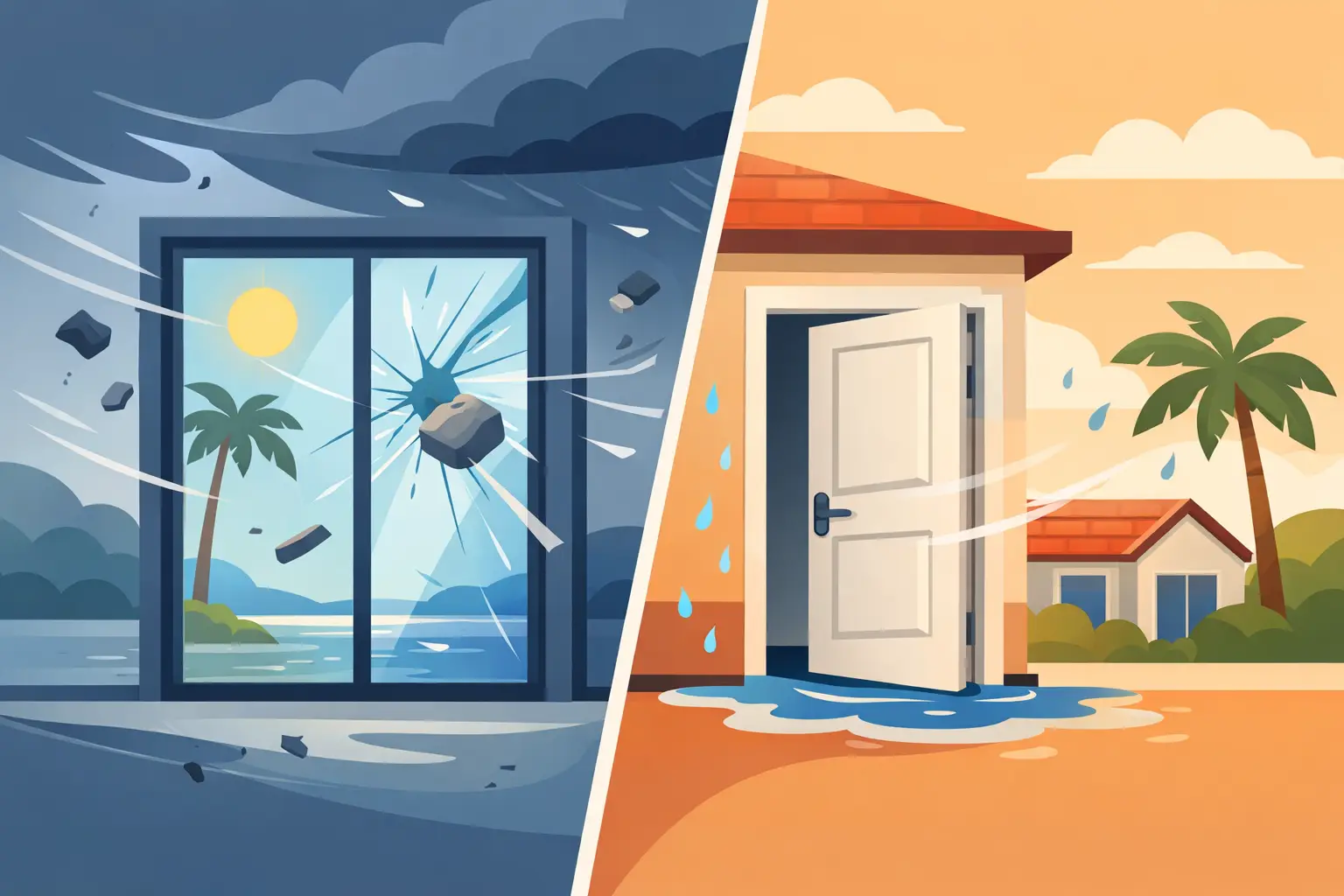
A door can be the weakest point in a Florida home when high winds, windborne debris, and wind-driven rain arrive. The choice between impact doors vs standard doors is not simply about appearance or the upfront price. It affects your property’s storm readiness, daily security, energy use, insurance considerations, and long-term maintenance needs.
For homeowners and property managers on the Treasure Coast, the right answer depends on where the building is located, how the opening is configured, and whether a standard door has approved storm protection in place. Here is what separates the two options and how to make a confident investment.
Impact Doors vs Standard Doors: The Core Difference
A standard exterior door is designed for normal daily use. It may offer solid construction, weatherstripping, insulated glass, and dependable security hardware, but it is not automatically engineered or tested to resist hurricane-force pressure and flying debris. Many standard glass doors can break when struck, leaving the interior exposed to wind and rain.
Impact doors are built as a complete protective system. Their frames, glass, seals, anchors, and hardware are designed to work together under severe weather conditions. The glass typically uses multiple layers bonded with a durable interlayer. If the outer layer cracks after an impact, the interlayer helps hold the broken glass in place rather than allowing an opening to form.
That distinction matters during a hurricane. Once a protected opening fails, changing air pressure can place extreme stress on the roof, walls, and other openings. An impact-rated door is intended to help maintain the building envelope when conditions become dangerous.
What Impact Doors Are Designed to Handle
Impact-rated doors are tested for specific performance requirements, including resistance to large and small missile impacts and repeated positive and negative pressure cycles. The applicable approval depends on the product, installation method, and local code requirements. A door cannot be considered properly protected based on the glass alone.
The frame must be rated for the system, securely fastened to the structure, and installed according to the manufacturer’s approved details. Locking mechanisms, rollers on sliding doors, thresholds, and perimeter seals all contribute to performance. This is why professional installation is as important as selecting a quality product.
A standard door may still be appropriate in some situations, particularly when it is protected by code-compliant accordion shutters, panels, or another approved storm-protection system. However, that approach requires preparation before a storm and regular attention to ensure the protection remains functional.
Glass retention is not the same as an unbreakable door
Impact glass can crack when hit by debris. Its advantage is that it is engineered to stay together and resist creating a dangerous breach. Property owners should not expect any glass product to look untouched after a direct strike. The goal is continued protection when it counts.
Hurricane Protection and Everyday Security
For coastal Florida properties, hurricane protection is usually the first reason to consider impact doors. Yet the day-to-day benefits are equally meaningful. Laminated impact glass is much harder to penetrate than ordinary glass, which can add a valuable layer of security for ground-floor entries, patio doors, and commercial storefront openings.
Impact doors may also reduce outside noise. The layered glass and tighter construction can help soften traffic, lawn equipment, and neighborhood noise. Results vary by product and the surrounding construction, but homeowners often notice a quieter interior after upgrading older sliding glass doors or entry systems.
Standard doors can provide good security when they have a strong frame, quality deadbolt, reinforced strike plate, and proper installation. Still, a standard glass door generally does not offer the same forced-entry resistance as a tested impact system.
Energy Efficiency Depends on More Than the Glass
Both impact and standard doors are available with energy-efficient features. Low-E coatings, insulated glass, quality weatherstripping, thermal breaks, and properly sealed frames can all help manage heat gain in Florida’s climate.
Impact doors often provide excellent air and water resistance because of their heavier construction and specialized seals. That can improve comfort near large glass openings and reduce the strain on air conditioning. But impact-rated does not automatically mean it is the most energy-efficient choice on the market. Review the product’s energy performance ratings and select glass options suited to your home’s orientation.
For example, a large west-facing sliding door may benefit from glass designed to reduce solar heat gain, while an opening under a covered lanai may have different priorities. A knowledgeable contractor can help balance daylight, visibility, heat control, and storm protection without treating every opening the same.
Cost: Upfront Price vs Long-Term Value
Impact doors cost more upfront than comparable standard doors. The additional cost reflects laminated glass, reinforced frames, tested components, and the engineering required for hurricane performance. Larger multi-panel sliders and custom configurations can increase the investment further.
The comparison becomes more balanced when standard doors need separate storm shutters or panels. Those systems have their own purchase, installation, storage, maintenance, and deployment costs. Before a storm, someone must also close or install them correctly. That can be challenging for seasonal residents, older homeowners, rental properties, and commercial buildings with multiple openings.
Impact doors provide permanent, ready-to-use protection without the need to install panels or close shutters before every storm. They may also support property value by giving prospective buyers a visible, practical upgrade. Insurance discounts may be available in some cases, but eligibility and savings vary by insurer, policy, and documentation. It is wise to confirm potential savings directly with your insurance provider before making a purchasing decision.
When Standard Doors May Still Make Sense
A standard door is not automatically the wrong choice. It can be a sensible option for an interior door, a protected exterior opening, or a property where approved shutters already provide reliable hurricane coverage. A homeowner may also choose a standard solid entry door with a separate storm-protection plan for budget or design reasons.
The key is not to assume that every door needs the same solution. A home with a sheltered side entry has different exposure than an ocean-facing sliding glass door. Local wind zone, proximity to the coast, opening size, building type, and local permitting requirements should guide the decision.
For rental and commercial properties, convenience can carry extra weight. Permanent impact protection can reduce the need to coordinate storm preparation across tenants, staff, or multiple units. For a primary residence, it can offer greater confidence when evacuation orders are issued and time is limited.
Why Installation Quality Cannot Be Overlooked
A premium impact door can underperform if it is installed incorrectly. Improper anchors, missing fasteners, poor flashing, inadequate sealant, or an out-of-square opening can affect water resistance, operation, and rated performance. Installation details must match the product approval and the existing wall construction.
Professional installers evaluate the rough opening, frame condition, drainage path, and attachment requirements before work begins. They also confirm that the selected door is appropriate for the opening size and location. This level of planning is especially important for replacements in older Florida homes, where hidden deterioration or nonstandard construction may need to be addressed.
At Jensen Beach Aluminum & Windows, skilled professionals help property owners evaluate doors as part of a complete protection plan, not as a one-size-fits-all purchase. The goal is a door system that looks right, operates smoothly, and is installed for lasting performance.
Questions to Ask Before Choosing a Door
Before approving a quote, ask whether the door has the required Florida approvals for your location and opening. Confirm what storm protection is included, which glass package is being specified, and how the product will be anchored and sealed. Also ask about warranty coverage for the door, glass, hardware, and installation.
If you are comparing proposals, make sure they describe comparable products. A lower price may reflect a standard door, a smaller frame, different glass, fewer hardware upgrades, or storm protection that is not included. Clear specifications help prevent costly surprises later.
A well-chosen door should do more than close securely. It should suit the way you use your home, stand up to the Florida climate, and give you a practical plan before the next storm season arrives. A professional on-site consultation can identify the openings where permanent impact protection will deliver the strongest return for your property.